
Asian American Voters in Georgia Strongly Supported Miracle Rankin in Georgia State Supreme Court Primary
FOR IMMEDIATE RELEASE:
May 20, 2026
Media Contact:
Nicole Kang
nicole@asianamericanadvocacyfund.org
Asian American Voters in Georgia Strongly Supported Miracle Rankin in Georgia State Supreme Court Primary
Post-election county-level analysis of districts show Asian American voters favored progressive candidate Rankin over Bethel by up to 26 percentage points
GEORGIA – New post-election county-level analysis in Georgia State Supreme Court highlighted that Asian American voters strongly supported progressive candidate Miracle Rankin and rejected extremist candidate Charlie Bethel in Tuesday’s tightly contested Georgia State Supreme Court race.
The post-election analysis was conducted by Tom K. Wong Consulting in partnership with Asian American Advocacy Fund (AAAF), and the Asian American Power Network (AAPN), the only national network of state-based 501(c)(4) Asian American and Pacific Islander (AAPI) organizations building political power through community organizing, shaping elections, and advancing policies that improve everyday lives.
The Asian American Advocacy Fund (AAAF) played a significant role in Asian American voter education, outreach, and turnout in this week’s election, making over 18,000 phone calls to Asian American voters across the state, sending 23,000 texts, and knocking on 16,000 doors.
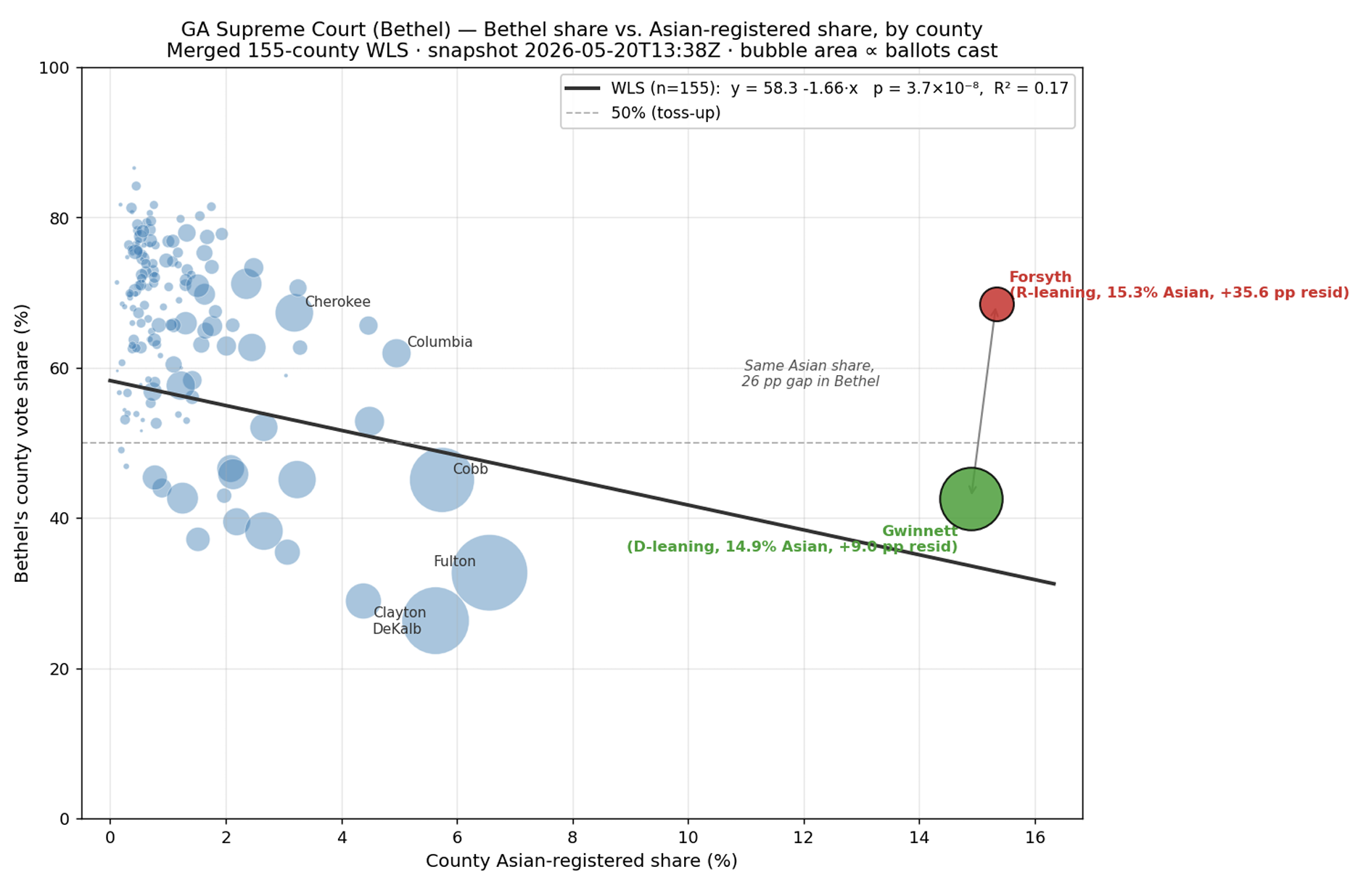
Results: This data shows that support for Bethel declines as the share of Asian-registered voters increases, with the trendline indicating a negative relationship across counties.
Disclaimer: See methodology below
Y-axis: Bethel’s vote share in Georgia counties
Size of the dot: how many total AAPI ballots cast (larger = more AAPI voters)
As the amount of of Asian American voters increases, Bethel’s vote share tends to decrease.
“Our post-election precinct-level analysis in Georgia's State Supreme Court race shows that Asian American voters can be the margins of victory in key progressive elections and races if we invest early and strategically,” said Mary Lou Akai-Ferguson, Executive Director of AAPN. “We cannot overlook Asian American voters as one of the fastest-growing, and decisive voting blocs in the country. This election season, in key battleground state after state, AAPN will continue to support sustained organizing to turn Asian American communities from an afterthought into a decisive electoral force.”
“Tuesday’s election results made one thing clear: Asian American voters in Georgia did our part where we had the resources for engagement,” said Ashna Khanna, Executive Director of AAAF. “Our communities turned out, organized, and overwhelmingly supported a vision for a more just and representative Georgia. This race underscored both the growing power of Asian American voters across the state and the consequences of failing to invest in our communities early and at the scale needed to push critical races across the finish line. We know that when Asian American voters are engaged consistently, spoken to directly, and meaningfully invested in, they turn out. To win future statewide races, we cannot afford to treat Asian American voters as an afterthought.”
Methodology: After the polls closed, precinct-level results were systematically collected from county election offices and cross-walked these results to voter files obtained from L2. Precinct-level results, though detailed, may not be fully certified. These precinct-level results can provide the first insights into what shaped election outcomes in key races throughout the state. Using the percentage share of voters in a precinct who are Asian, as well as raw counts of Asian voters, a series of bivariate regressions are run to examine initial correlations. We note it is premature to claim causality. After election results are fully certified and voter files are updated with turnout, we will move beyond bivariate approaches to employ more rigorous causal inference techniques and adjust for potential confounders.
##